
Must-Read Blog to understand Nishikigoi
- 2025年9月10日
- 読了時間: 19分
更新日:4月24日
Table of contents
The History of Nishiki Goi
Have you ever wondered when and where Nishikigoi—Japan's famous ornamental carp—was first born? Surprisingly, behind their elegant beauty lies a story rooted in the snowy mountains of Niigata Prefecture, where harsh winters and human ingenuity gave birth to one of Japan's most celebrated symbols of craftsmanship and aesthetics.
1. From Food to Fortune
Back in the Edo period (around the 1700s), farmers in a remote Niigata village called Niju-mura, now part of Nagaoka City, kept Magoi (black carp) as a source of food. In this heavy snowfall region, winter often buried houses under several meters of snow, cutting people off from the outside world. Carp raised in ponds became a vital source of protein that helped families survive through the long, cold season.
2. The Birth of Color Through Mutation
In the early 19th century (the Bunka and Bunsei eras), something remarkable happened. Among the ordinary black carp, a few fish appeared with unusual colors—patches of red or white, caused by spontaneous mutations. Rather than seeing these fish as food, local breeders saw potential for beauty. They began selectively breeding the most striking individuals, patiently experimenting to see which combinations produced desirable patterns.
Through persistence and observation, they discovered that specific color pairings produced predictable offspring. This discovery marked the beginning of Nishikigoi as ornamental fish—a shift from breeding for survival to breeding for beauty.
3. The Name "Nishikigoi" and Its Global Fame
Initially, these colorful carp were known by simple names such as "Irogoi" (colored carp) or "kawari-goi" (unusual carp). But their popularity spread nationwide after being exhibited at the Tokyo Taisho Expo in the early 20th century, where they captured the hearts of visitors.
By the 1960s, with advances in air transport and plastic-bag shipping, Nishikigoi began traveling overseas. They soon became prized by collectors and enthusiasts around the world, admired as "Swimming Jewels" representing Japanese artistry and patience.
Timeline of Nishikigoi Evolution

Edo Period:
Mutations appear in Niigata, giving rise to red and white varieties from black food carp.
Meiji–Taisho Eras:
Breeders begin fixing varieties such as the classic Kohaku (red and white).
Showa Era (Postwar):
Exports expand; “Nishikigoi” becomes a global phenomenon.
Modern Day:
Digital platforms and live auctions connect breeders and buyers worldwide, with some fish fetching prices in the millions.
Beyond their physical beauty, Nishikigoi represent the profound harmony between nature, perseverance, and artistry. Every shimmering scale tells a story spanning over 200 years of dedication by generations of breeders who transformed necessity into art. To understand Nishikigoi is to appreciate not just a beautiful fish—but the enduring spirit of Japanese craftsmanship itself.
The Bloodlines and Varieties of Nishikigoi
When admiring Nishikigoi, their brilliant colors and mesmerizing patterns immediately catch the eye. But knowing a koi's background—its lineage and variety— adds an entirely new depth to the experience. Let's explore the world of Nishikigoi bloodlines and what makes each variety unique.

1. The "Gosanke (Big 3)" Varieties
Every koi enthusiast should start with the Gosanke, the three most iconic and revered varieties—the foundation and pinnacle of all Nishikigoi.
Kohaku (紅白): White body with red markings. It's said that "Nishiki Goi appreciation begins and ends with Kohaku." Simple yet endlessly deep, Kohaku often claims the top prizes in koi shows.

Taisho Sanshoku (大正三色): A white base with red and black markings. Introduced during the Taisho era, this variety adds dynamic contrast to the elegance of Kohaku.

Showa Sanshoku (昭和三色): A black base adorned with red and white patterns. Known for its bold and powerful look, it differs from Taisho Sanke in that its base color is black rather than white.

2. Lineage and Breeding Tree
Modern Nishikigoi varieties are the result of centuries of selective breeding combined with natural mutations. Tracing their genealogy reveals fascinating relationships.
From the original black carp (magoi), breeders developed:
→ Asagi – The ancestor of almost all color varieties, with delicate reticulated blue scales.
→ Kohaku – Known for its striking red-on-white contrast.
→ Shusui – A cross between the scaleless German carp and Asagi, featuring bold lateral scales.
→ Karasugoi – Jet-black koi known for their mystery and strength.
→ Showa Sanshoku – Carrying forward the deep beauty of black from its lineage.
Even Nishiki Goi that appear completely different—such as Asagi, Kohaku, or Showa—can trace their ancestry back to the same source. That shared origin is what connects the diverse world of Nishikigoi into a single evolving art form.
3. Why Bloodlines Matter
Top koi breeders don't simply pair two beautiful fish at random. Each breeding decision is based on profound knowledge of lineage and genetic inheritance.
Body shape and size are mainly inherited from the female parent.
Color and pattern sharpness often come from the male parent.
Pattern unpredictability remains the biggest mystery—out of tens of thousands of fry, only a tiny fraction develop the ideal markings. This near-impossible probability is a key reason why exceptional koi are so valuable.
In essence, bloodline is more than a brand name—it's a predictive tool showing what potential lies within each young koi as it matures.
4. The Influence of German Carp
A turning point in koi history came during the Meiji era, when Japan introduced mirror carp from Germany for food production. These scaleless carp were later bred with Japanese koi to create a new style known as the Doitsu koi(German koi).
Doitsu koi often lack scales or have large, reflective ones along the lateral line, giving their patterns a clean, vivid appearance. This trait remains highly prized among modern collectors for its striking visual impact.
5. Popular Varieties Today
Kohaku (紅白) – White and red, symbolizing purity and balance.
Ogon (黄金) – A single, gleaming gold body that exudes prosperity and good fortune.
Tancho (丹頂) – Pure white with a single red circle on its head, resembling Japan's national flag.
In the world of Nishikigoi, pedigree equals trust. Knowing that "This koi descended from a grand champion bloodline" isn't just a matter of prestige—it's valuable insight into how the fish will grow, transform, and possibly achieve beauty worthy of a legend.
Each koi carries both visible elegance and hidden heritage, telling a story shaped by generations of Japanese breeders pursuing perfection in living form.
How to get Nishiki Goi
When you decide, "Alright, I'm going to keep Nishikigoi," where do you actually go to buy your first koi? Even in today's convenient, internet-driven world, the koi industry still runs on a very traditional value: trust.
1. Koi Specialty Shops: Best for Beginners
For beginners, the most recommended option is buying from a Nishikigoi specialty shop.
Advantages:
You can compare Nishiki Goi from various breeders in one place, and you'll usually get solid aftercare support: advice on pond and filtration equipment, water quality management, disease prevention, and treatment.
How to choose a good shop:
Check whether the pond water is clear, whether the koi are actively and healthily swimming, and, most importantly, whether the owner takes time to answer a beginner's questions politely and thoroughly.
Specialty shops play a vital role as a bridge between breeders and hobbyists, helping not only to sell fish but to preserve and pass on the wider culture of Nishikigoi.
2. The Challenge of Buying Direct from Breeders
In koi "Holy lands" like Niigata, there are many professional breeders, known as Koishi(Nishiki Goi Masters). But if a beginner suddenly shows up at a farm and says, "Please sell me one koi" it's not unusual to be politely turned away.
It's similar to visiting a Scotch whisky distillery in Scotland or a winery in Italy unannounced and expecting to buy just one bottle on the spot. These are production sites, not regular retail shops.
For breeders, Nishikigoi are living creatures and often feel like their own children. Entrusting a carefully raised koi to someone whose keeping environment they know nothing about is a big emotional risk. Only when a mutual relationship of trust has been built will a breeder feel comfortable selling directly.
On top of that, many koi farms primarily do business with domestic and overseas dealers and wholesalers. They are not always set up to handle individual retail customers, and their business is often structured around bulk or trade-level sales.
Breeders are also extremely busy and work year-round because they handle live animals. Casual drop-ins or visits without any knowledge or preparation can waste their professional time—and may mean you will not be welcomed back in the future.
3. How to Build a Relationship with a Breeder
If you have your heart set on koi from a particular breeder, it is essential to follow a few steps.
Go through a specialty shop first:
Speak with a shop owner you already know and trust. Tell them, "I'd like koi from XYZ Koi Farm" and ask if they can introduce you. Of course, this works best if you have already built a friendly relationship with that shop owner.
Make appointments and be respectful:
Never just turn up at a farm unannounced. Always contact them in advance, make an appointment, and learn about that breeder's philosophy and priorities before you visit.
These steps show that you respect their time, their work, and their fish—and that you're serious about becoming part of the Nishikigoi community.
4. Buying via Auctions and Online Shops
Online purchasing has become very common. It's convenient, but judging body shape and color quality from photos alone is extremely difficult, even for experienced keepers.
For your first koi, it is strongly recommended that you choose fish that have already been selected and vetted by a trusted professional. Once you gain experience and a trained eye, auctions and online platforms can be useful tools—but they are not the ideal starting point.
5. Comparison of Purchase Options
Purchase route Convenience Support & expertise Suitable for beginners? Main risks or limitations
Home centers | -Very easy, widely accessible -Staff rarely have in-depth koi knowledge -Lower quality fish, poor advice, limited follow-up |
Koi specialty shops | -Easy to visit, koi-focused environment -Strong guidance, aftercare, and education -Quality varies by shop, so selection is important |
Online shops | -Very convenient, can buy from anywhere -No in-person support -Only with guidance from a trusted pro -Cannot see the fish in person before purchase |
Breeders (koi farms) | -Not easily accessible, by relationship -Top-level quality and depth of knowledge -For advanced hobbyists with connections -Requires trust, appointments, and trade-level ties |
Nishikigoi can live as long as a dog or a cat. You’re choosing a partner that may stay with you for 10 or even 20 years.
Rather than focusing on "getting the lowest price," aim to become the kind of keeper whom professionals feel they can trust with the future of their koi. When a breeder or shop owner feels, "I would gladly entrust this fish to you," that's when your real journey with Nishikigoi begins.
How to keep Nishiki Goi
You don't need a grand Japanese garden to keep Nishikigoi. Even in a regular apartment, as long as you have a suitable aquarium, you can absolutely enjoy keeping koi at home.

1. You Don't Need a Traditional Garden
Of course, the ideal image is koi swimming freely in a large outdoor pond, but in modern life, more and more enthusiasts are enjoying tank keeping indoors.
If you have a yard:
You can create a solid koi space simply by installing a prefabricated plastic pond in the ground. It's a simple setup that still offers a surprisingly authentic feel.
If you live in an apartment:
With an aquarium of 90 cm or larger, you can comfortably keep several young koi around 20–30 cm in length. As a piece of living interior décor, few things are as luxurious as a tank of beautiful Nishikigoi.

2. The Three Essentials for Healthy Koi
There are three things you must never compromise on if you want to keep your koi healthy and thriving.
Powerful filtration system
Koi eat a lot and produce a lot of waste, so the water gets dirty quickly. You'll need a filter with higher capacity than the ones typically used for tropical fish.
Air pump (oxygen supply)
Koi consume a lot of oxygen. An air pump that constantly supplies bubbles is essential to keep the water well-oxygenated.
Dechlorinator
Tap water in Japan contains chlorine, which is harmful to koi. Always use a water conditioner to remove chlorine and create water that is safe and gentle for your fish.
3. Three Common Beginner Pitfalls
To avoid early failures, keep these three strategic points in mind.
Overstocking
Putting too many koi into a small tank quickly degrades water quality and greatly increases the risk of mass die-off. The golden rule is to start with "fewer than you think you want."
Overfeeding
It's hard to resist when koi eagerly beg for food at the surface, but overfeeding leads to obesity and poor water quality. In winter especially, their metabolism slows, so you must have the discipline to cut back on feeding.
Jumping accidents
Koi are surprisingly strong jumpers. Always use a lid or net on your tank or pond to prevent them from leaping out.
4. Choosing Your Ideal Setup
Keeping style, pros and cons, and space needed:
Pros | Cons | |
Full-scale pond (A water depth of at least 1 meter is recommended.) | Allows koi to grow large, creates an impressive, dynamic display. | High construction and maintenance costs. |
Plastic pond in the yard (Plan on about 1.6 m²of space or more.) | Easy to install and close to a natural environment. | Watch out for high water temperatures in summer. |
Large indoor aquarium (A tank 90–120 cm wide or larger is recommended.) | You can enjoy viewing koi from the side as well as from above. | Practical limit to the size and number of koi you can keep. |
There is a famous saying in koi keeping: "Before you keep fish, keep water."
Even if the water looks clear, if ammonia and other harmful substances build up, the environment becomes stressful and dangerous for koi. Raising beneficial bacteria in your filter and maintaining stable, high-quality water is the one true key to making your Nishikigoi shine with lasting beauty.
How to take Nishiki Goi from Japan to your country
Many people dream of buying Nishikigoi in Japan and keeping them back home. It is possible, but you need to clear several important hurdles. Here is an overview of the key points for smooth export and an introduction to Japan's unique "Azukegoi" (koi boarding) culture.

1. You Cannot Take Nishikigoi as Hand Luggage
The first and most important rule: you cannot take Nishikigoi home as personal hand luggage or checked baggage on a flight.
To export koi, you need an official Export Health Certificate issued by the Animal Quarantine Service in Japan, and the fish must be shipped as cargo using proper oxygen packing through a professional export agent. Attempting to carry koi yourself like a regular suitcase is not allowed and risks both legal and animal welfare problems.
2. Exportable Countries and Quarantine Rules
Import regulations for Nishikigoi vary widely from country to country.
In many regions—including the United States, EU countries, China, Southeast Asia, and parts of the Middle East—imports of Japanese koi are possible under defined conditions.
On the other hand, countries like Australia have extremely strict controls on non‑native species to protect their ecosystems, so importing Nishikigoi from Japan is heavily restricted or effectively impossible for private hobbyists.
Most countries also require that koi test negative for diseases such as KHV (Koi Herpesvirus) and SVC (Spring Viraemia of Carp).
Check-lists when considering a purchase
-Whether the specific fish can legally be exported to your country.
-Whether the shop or agent has a proven track record of exporting to your region.
3. Japan's Unique "Azukegoi" (Boarding Koi) Culture
If you feel the urge to "take my koi home right now," it may be worth pausing. Many top hobbyists around the world choose a different path: leaving their koi in Japan as Azukegoi.

Azukegoi means that after buying a koi, you leave it in the breeder's ponds in Japan and ask the breeder to continue raising it for you.
Why leave your koi in Japan?
In Niigata and other koi heartlands, koi grow in large mud ponds under the care of top professionals. This environment often produces far better growth, color, and skin quality than most private ponds overseas.
To enter prestigious Japanese koi shows—such as the All Japan Nishikigoi Show—the fish must generally be kept in Japan, so many enthusiasts board their koi with trusted breeders and visit Japan once or several times a year to "meet" their fish. Your koi is literally waiting for you in Japan.
Young koi are sensitive to environmental change. By keeping them in Japan until they are larger and stronger, you reduce the risks associated with long‑distance transport.
For koi with strong future potential, boarding them in Japan is often the wisest choice.
4. From Purchase to Export: Basic Flow
Here is a typical step‑by‑step outline.
Buy from an export‑capable shop or agent
Choose a dealer with an export license and extensive experience shipping Nishikigoi overseas. They understand both Japanese procedures and the requirements of your country.
Quarantine period
Before shipment, koi are kept in a dedicated quarantine facility for a certain period to monitor health and ensure they are free from notifiable diseases.
Document preparation
Professionals handle the paperwork, including the Export Health Certificate and any additional documents required by the importing country.
International transport
The koi are packed in oxygenated bags, placed in insulated boxes, and shipped via cargo flight to the designated airport in your country, where they will undergo any final import inspections.
5. Export vs. Azukegoi: Two Different Strategies
Direct export | Azukegoi | |
Location | Enjoy your koi every day in your own pond or tank. | Follow your koi's growth through photos, videos, social media, and occasional visits to Japan. |
Quality | Growth and color quality depend entirely on your local environment and care. | Your koi grows in some of the best conditions. |
Cost | Shipping, inspection, and any customs fees upfront. | Annual boarding fee to the breeder |
Main purpose | Daily enjoyment as a hobby. | Potential prize‑winning, or investment value. |
If your koi is still young and full of potential, choosing Azukegoi is highly recommended. Under Japan's 4 seasons and the expert care of a skilled breeder, your koi might, in a few years' time, develop a level of beauty you can't yet imagine.
Export procedures are complex, but you don't need to handle everything yourself. Working with a trustworthy agent—whether a tour guide familiar with koi, a specialist shop, or an export broker—allows you to focus on what matters most: choosing koi you truly love, and building a long‑term relationship with the people who care for them.
What is All Japan Combined Nishikigoi Show
Koi shows are a central stage of the Nishikigoi world, where breeder technique, owner dedication, and the koi's innate potential all collide in one intense moment of competition.

1. The All Japan Combined Nishikigoi Show
One of the largest and most prestigious events is the All Japan Combined Nishikigoi Show, held annually in Tokyo. Breeders and hobbyists from around the globe bring thousands of koi to compete there.
Many international enthusiasts and dealers travel to Japan specifically for this event, watching in breathless anticipation as their prized koi vie for the coveted title of Grand Champion, the highest honor a koi can receive.

2. What Are Judges Looking For?
To win at a major show, a koi must excel in three key areas, all in perfect balance.
Body (conformation)
This is the most important factor. Judges look for a powerful yet graceful torpedo-shaped body and a strong skeletal frame that suggests the koi will continue to grow impressively in the future, not just be "fat".
Color quality
The depth and sharpness of the red, the purity of the white, and the richness of the black are all carefully examined. The skin should have a luminous, porcelain-like sheen that reflects top-level health and care.
Pattern
Good patterning is about more than beauty at a glance. Judges assess left–right balance and how the pattern flows from head to tail. The best koi combine unique character with a sense of dignity and harmony.
3. Auction Fever: When One Koi Sells for Millions
Koi that win high prizes—or are expected to win—often skyrocket in commercial value.
In one famous case, a single Kohaku was sold at auction for around 200 million yen, making international headlines. Why such a price? Because that koi was considered a once‑in‑a‑lifetime miracle, the kind of living artwork that may never appear again.
Just like a masterpiece by Van Gogh or Banksy, the value of a top Nishikigoi comes from rarity, emotional impact, and the story it carries, as much as from its physical beauty.
4. How Beginners Can Enjoy a Koi Show
Koi shows are not just for professionals or the ultra‑wealthy. They are open and enjoyable for ordinary hobbyists and curious visitors as well. Koi Plus Travel Concierge, for example, has exhibited at shows not as a koi dealer, but to promote koi‑related tourism experiences.
Here are some beginner-friendly ways to enjoy a show:
Find your "favorite" variety
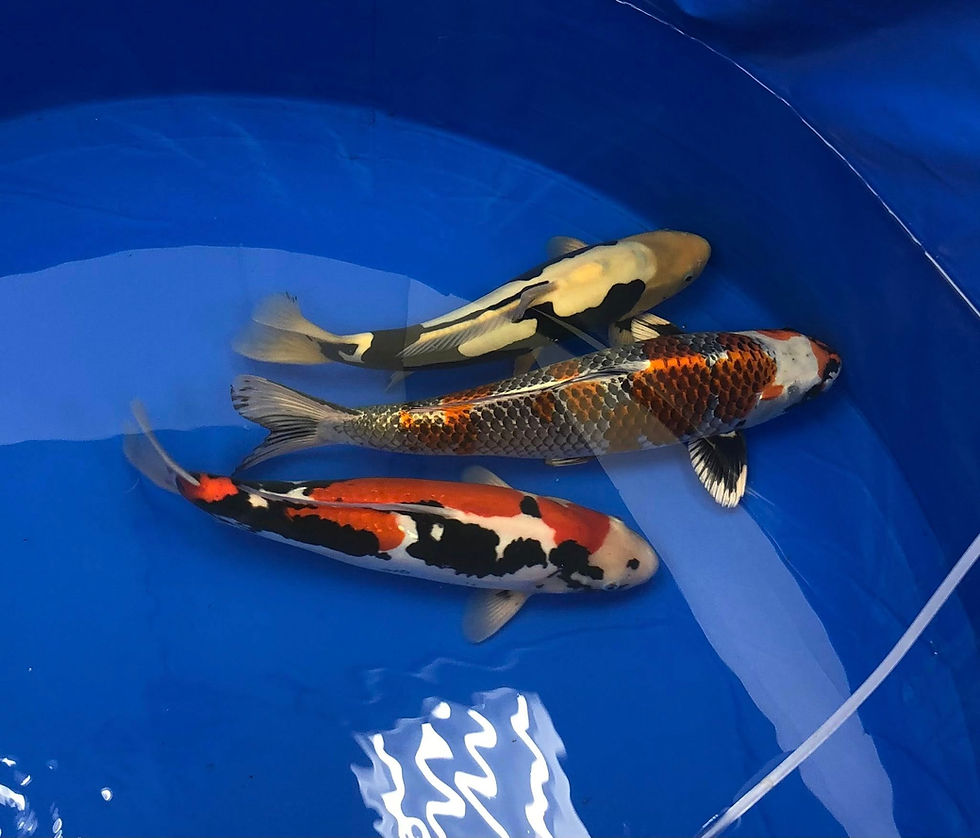
Wander among the hundreds of blue show vats and look for the varieties that appeal to you most. The exciting part is that in those tanks, you're not just seeing your favorite types—you’re seeing some of the very best examples in the world.
Look for sales corners
Many shows include sections where breeders sell young koi at accessible prices. At one event, there was even a live auction happening right in front of our booth.
Listen to the experts
Conversations between judges and veteran hobbyists are full of insights you'll never find in textbooks. Simply listening nearby can rapidly sharpen your eye for koi quality.
5. The Value Pyramid of Nishikigoi
Below is a simple "value pyramid" that illustrates how koi are generally ranked:
Rank | Characteristics | Typical value range |
Grand Champion level | Virtually no flaws, overwhelming presence and power | Tens of millions to billions of yen (enough to buy a house) |
Prize‑winning (top tier) | Excellent color and body, very high future potential | Hundreds of thousands to over 10 million yen |
Hobbyist grade | Well-balanced pattern, high ornamental value | Tens of thousands to several hundred thousand yen |
Pond / general grade | Healthy and attractive, ideal for home enjoyment | A few thousand to tens of thousands of yen |
Koi shows distill the entire culture of Nishikigoi into a single arena—craftsmanship, passion, competition, and art all on display in living, swimming form. For anyone wanting to understand the true depth of koi culture, stepping into a show venue at least once is an unforgettable experience.
Selection of Nishikigoi
The radiant beauty of Nishikigoi is supported by a much harsher reality than most people ever see. To truly understand koi as "living art", we also need to understand the world of selection—a process that is as ruthless as it is essential.

1. Chasing the "One Percent Miracle"
A single spawning can produce hundreds of thousands of eggs, but only a tiny fraction will ever grow up as true Nishikigoi.
To create top-quality koi, breeders must carefully identify which fry have the potential to become great and which do not. This is done through repeated rounds of selection.
First selection:
At around one month of age, breeders check the young koi for basic body shape and the first hints of color. At this stage, tens of thousands of fry are reduced to just a few thousand.
Repeated culling:
As the koi grow, second, third, and further rounds of selection are carried out. With each stage, the standards become stricter.
By the end, the number of fish that remain as true "first-class" Nishikigoi—good enough for shows or the high-end market—is well under 1% of the original fry. The reality is that the other 99% fall out of the line somewhere along the way as "non-selected" fish.
2. What Happens to "Non-Selected" Koi?
So what becomes of the koi that don't make the cut? There are several paths that help ensure their lives and resources are not wasted.
Sold as low-priced juveniles
Healthy fish whose patterns don't meet strict standards are distributed as inexpensive young koi, often for casual hobbyists or for use in "koi scooping" games at summer festivals. In Japan, you might encounter them at stalls set up in shrine festivals across the country.
New life as ornamental pets
A koi that a professional breeder considers "not quite good enough" can still be beautiful and charming to ordinary keepers. Many of these fish go on to live long, happy lives as beloved pets in home ponds and tanks.
Returned to the cycle of nature
The harshest reality is that fry with deformed bodies, serious defects, or no useful coloration at an early stage may be used as feed, processed as food, or otherwise returned to the local ecological cycle. This too is part of how breeders avoid wasting life and resources.
3. The Breeder's Struggle and Resolve
For breeders, selection is one of the most mentally and emotionally draining tasks of their work. Using a small net and trained eyes, they scoop up each tiny koi and, in an instant, judge its future.

Why carry out something that seems so cruel? Because pond space and resources are limited.
If breeders tried to raise every single fry, ponds would quickly become overcrowded, water quality would collapse, and disease could wipe out the entire population. By narrowing down the numbers, they can focus their time, care, and space on the koi with the highest potential.
In other words, to protect and develop the very best Nishikigoi, breeders must shoulder the heavy responsibility of choosing which lives to continue investing in—and which to let go.
4. What This Means for Us
With this reality in mind, take another look at the koi swimming in your pond or aquarium.
That one fish in front of you is a survivor, chosen from tens of thousands of siblings. Even if it is not a top show winner or an expensive "high-end" koi, the fact that it reached you at all means it has passed through multiple stages of selection and survival.
It is, in its own way, a small miracle.
5. A Rough Picture of Survival Rates
Here is a simplified image of how numbers decrease at each stage:
Phase | The amount | Conditions |
Spawning and hatching | 100,000 fry | Tiny, grain-like babies just beginning life |
First selection | 10,000 fry | Fish with poor shape or completely unsuitable color are removed |
Third selection | 1,000 fry | Only those with clearer patterns and better potential remain |
Final stage (around 2nd year) | fewer than 100 koi | the fish that finally reach the market as true Nishikigoi or are entered into shows |
The word "Selection" may sound cold and unforgiving. Yet, it is precisely this process—repeated day after day since the Edo period—that has allowed Japanese breeders to refine Nishikigoi into the level of art we admire today.
Knowing this truth, perhaps we can appreciate each koi not just as a pretty fish, but as a life that has passed through countless choices, efforts, and sacrifices to reach us.
If you're captivated by Nishikigoi, you'll want to set foot in its birthplace—Niigata Prefecture. But venturing alone into the world of koi farms, where language barriers and unique customs prevail, can be daunting. That's where Koi Plus Travel Concierge steps in, offering exclusive "Nishikigoi experiences" that individuals could never access on their own.

1. Learning Opportunities for All Levels—from Beginners to Enthusiasts
We're not dealers focused on buying and selling koi. Instead, we connect you directly with local facilities for immersive learning about Nishikigoi history and culture.
Discover how Niigata's harsh snowy winters shaped these living jewels. Understanding this context transforms a fish you once admired simply as "beautiful" into a profound symbol at the heart of Japanese heritage.
2. Exclusive Access to Professional Koi Farms
We arrange special visits to working koi farms—professional sites typically off-limits to outsiders.
Witness the intensity of the selection process, observe masters managing mud ponds and water quality, and even experience hands-on tasks like feeding in natural wild ponds or modern houses. This level of access comes from our established relationships of trust with breeders, making it a signature Koi Plus Travel Concierge service.
3. The "Sharing of Life" Experience
Remember the story of selection we discussed earlier? Many koi don't meet professional market standards and never reach commercial channels. Yet each one is a precious life.
Through the generosity of breeders on our tours, you'll have the chance to receive one of these koi as a heartfelt "gift". Receiving and cherishing a single life in this way creates the most moving, soul-warming moment of the journey.
4. Nishikigoi as a Gateway to Japanese Arts
Nishikigoi are deeply intertwined with Japanese gardens, architecture, and crafts.
Explore the design of gardens optimized for viewing koi at their most beautiful, or traditional crafts inspired by their vibrant colors. Starting from Nishikigoi, our experiences weave through the broader tapestry of Japanese artistry—truly an intellectual and luxurious pursuit for discerning adults.
Travel is an investment in discovering a new you.
Breathing Niigata's mountain air, shaking the calloused hands of a master breeder, hearing the splash of koi breaking the water's surface—these real experiences become the greatest enrichment for your life.
Koi Plus Travel Concierge isn't just a guide service. We are the bridge connecting you, Nishikigoi, and Japanese culture in ways that create lasting bonds.
Contact & Appointments
For meeting appointments, please feel free to send us a message.
We look forward to welcoming you in Japan, too!
This is our email→ office@miit-info.com
If you have any questions, please contact from here↓
Contact via LINE app↓
For more information, please visit the link below or contact us directly.
#Businesstravel #Japagrit #Japantour #Osakaguide #Businessnetworking #Investors #Businesstourism #Hiddengems #Osaka #CoworkingSpace #Entrepreneurship #Expo2025 #IntegratedResort #Japagrit #JapanTraditionalCrafts #CulturePreneur #BusinessTravel #Japagrit #InboundTourism #BusinessTravel #CulturalExperiences #Japagrit #Taiwan #SmartCapital #Investment #InspectionTour #Koiplustravelconcierge #Nishikigoi


コメント